
Why Farmland is the Ultimate HALO Investment Strategy
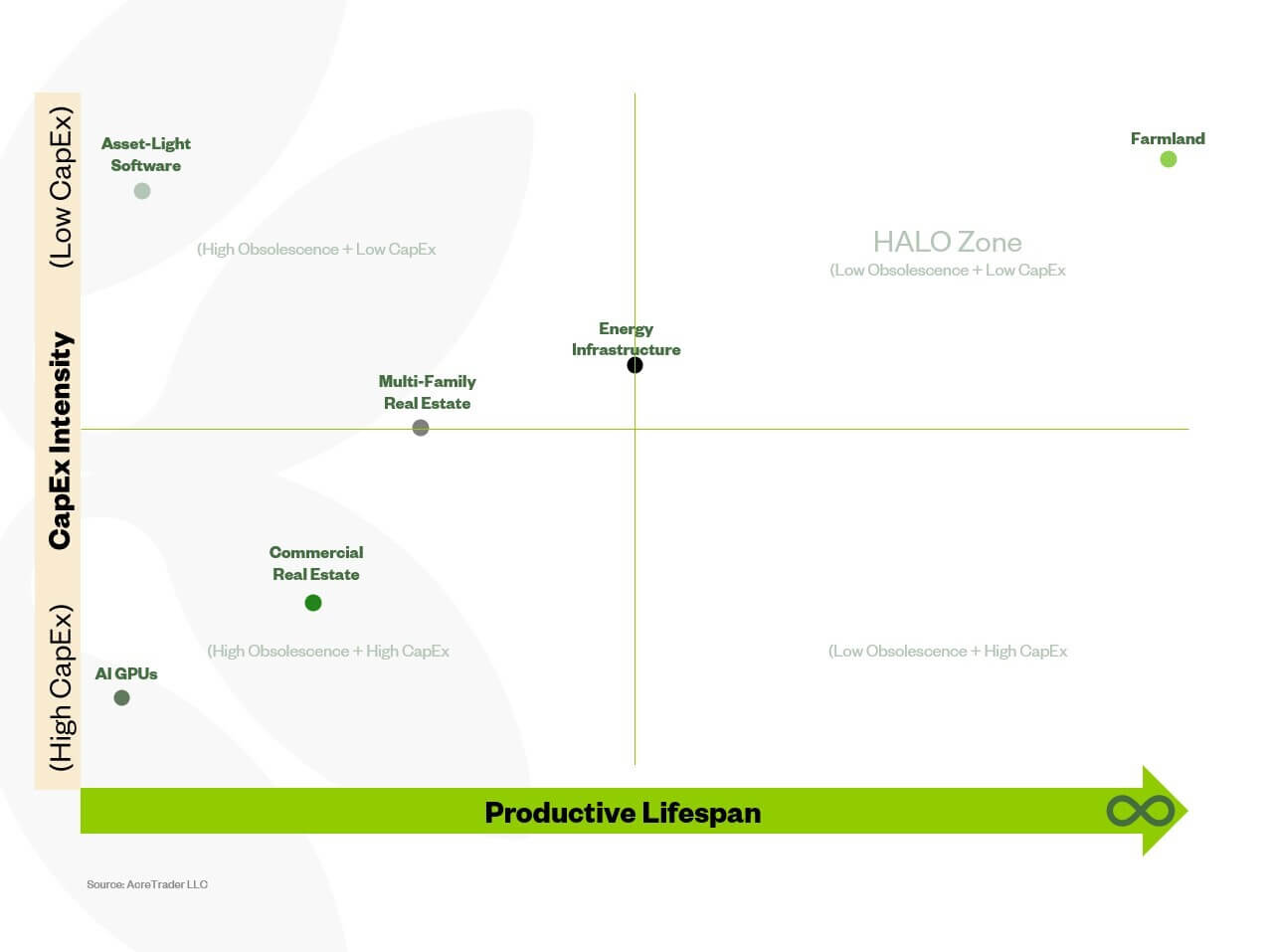
The asset management industry has come to appreciate the importance of HALO investing - Hard Assets, Low Obsolescence. In an age of accelerating technological disruption, the assets least likely to be replaced may provide a safe harbor from obsolescence. Prior to 2022, asset-light businesses such as software and platforms that scaled quickly and required minimal capital intensity received significant investment capital and were rewarded with very strong valuations. However in a world where artificial intelligence (AI) can replicate intangible work, asset-light businesses face greater risk of obsolescence than they once did.
Many investors have looked to energy, industrial, and logistics stocks as a way to insulate portfolios from potential obsolescence risk. As more private market alternatives have emerged, this theme has spread to more physical assets such as real estate and energy infrastructure. Not only can AI not replicate many of these critical physical assets, it depends on them.
Few, if any, real assets have shown to be as durable as land and water rights. Over millennia farmland has remained a physical asset with intrinsic utility. Quite literally, physical soil and water rights are required to sustain human life. In addition, due to urbanization and industrial expansion, the amount of arable land per capita is steadily shrinking globally. For example, according to the USDA Census of Agriculture, there were 445.3 million acres of cropland in the United States in 1997. That number dropped to 382.4 million acres of cropland in 2022. That’s a loss of 4.8 acres every minute in this country.
This key principle underpins the durability of farmland as an asset class. Other HALO investments, such as energy grid infrastructure and data centers, are currently experiencing an influx of investment capital that is expanding the supply base. That dynamic does not apply to farmland and water rights, the supply base of which is continuously shrinking against a backdrop of increasing demand. Other hard assets in the past were thought to be unassailable, however ultimately experienced obsolescence risk: office towers from remote work, coal fired power plants from energy transition, malls from e-commerce.
Furthermore, farmland, specifically annual cropland, carries very little improvement value and minimal depreciating assets that must be maintained or replaced. A tremendous amount of capital is currently being deployed to build out the AI infrastructure, though the obsolescence risk is very much up for debate.The true economic lifespan of an AI GPU is incredibly short due to rapid obsolescence and the fact that AI workloads are the most power-intensive in computing history. New GPU architectures are shipped every 12-18 months(1), with each new generation delivering 2x-3x the performance per watt(2).
Historically, farmland has benefitted from technological disruption, serving as an enhancement rather than a replacement for agriculture. The invention of the tractor, synthetic fertilizers, new seed varieties, GPS-guided combines, and now AI to augment agronomic analysis did not make farmland obsolete; they made it drastically more productive and valuable.
The core tenet to HALO investing is durability. This durability should lead to capital appreciation and inflation protection. Durable assets should survive technological disruption, absorb inflation and demonstrate absolute permanence and irreplaceable scarcity. With farmland’s underlying supply and demand dynamics, historical positive correlation to inflation, insulation from technological disruption, and role as a mission critical natural resource, it’s hard to argue that any asset class fits the definition of Hard Asset, Low Obsolescence any better.
(1) https://www.vcluster.com/guides/ai-cloud-providers-cost-of-delaying-managed-kubernetes
(2) https://premium.f1gmat.com/technology/trends/2026/Q1

Managing Director
Drew Lipke joined AcreTrader in 2021 and serves as Managing Director, leading the sourcing and underwriting of farms acquired and managed by AcreTrader LLC. Drew brings more than 14 years of experience across debt and equity capital markets, including roles in corporate credit analysis, equity research, and institutional equity sales. Prior to AcreTrader, Drew spent 12 years at Stephens Inc. covering multiple sectors including aerospace and defense, energy exploration and production, and building materials and construction services, and later served as Managing Director of corporate credit analysis at a fixed-income broker dealer. A Little Rock native, Drew has owned farmland in Arkansas for over a decade. He holds Series 7, 24, 63, 79, 86, and 87 licenses with FINRA and is a registered representative of North Capital Private Securities. Drew earned his degree from the University of Georgia’s Terry College of Business and was recognized by Institutional Investor as an All-America Research Team Rising Star.