
Opportunities and Risks for Senior Water Rights in the Colorado River Basin
Key Points
- The United States Supreme Court issued a final and binding ruling on California’s Colorado River water rights in 1964.
- Water rights are permanently and legally bound to farmland and these rights create a strong financial asset.
- While the Colorado River Basin has faced a 20 year drought resulting in the entire basin in deficit, a pending 2026 Agreement is likely to abide by the established legal entitlements of the river.
- Any potential curtailments of Colorado River surface water rights will be borne by more junior water rights holders first and/or require meaningful compensation to California’s senior water rights holders.
Water Rights are a Critical Asset
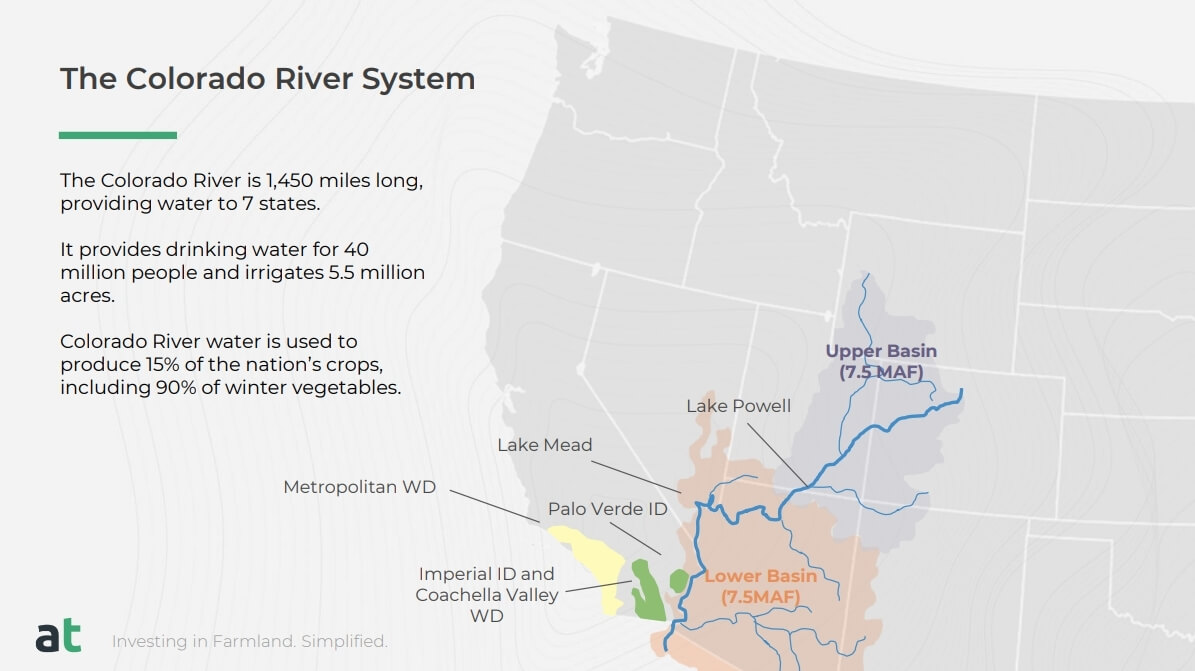
Owning farmland in the Palo Verde Irrigation District, California’s Yuma Project, the Imperial Valley, or Coachella Valley means you do not simply hold title to the land, you own a legally guaranteed piece of the Colorado River. The water delivered from the Colorado River transforms these arid valleys into a multi-billion dollar agricultural powerhouse. These valleys produce 80%-90% of the United States’ leafy greens and salad vegetables during the winter months and represent a critical growing region for this country.
Figure 1 - The Colorado River System
 Source: AcreTrader
California carries the most senior water rights on the Colorado River, the legal basis of which was solidified in the Boulder Canyon Project Act of 1928 and the Supreme Court (Arizona v. California - 1963), which apportioned 4.4 million acre-feet annually to California. In the 1931 Seven Party Agreement California’s major water users agreed to a priority system for their share of the water. This established the hierarchy of water distribution among California’s primary water users, with Palo Verde Irrigation District holding first priority, the California Yuma Project in second priority, Imperial Irrigation District and Coachella Valley Water District in third priority.
In the United States, water rights are “appurtenant” to the title of the farmland, meaning that the water right is permanently attached to the land itself. These water rights provide farmers in regions such as the Coachella Valley a license to grow high-value crops such as winter vegetables, bell peppers, grapes and citrus. The immense value of these Colorado River water rights are capitalized directly into the land and these perfected rights are private property.
Senior Rights During Times of Drought
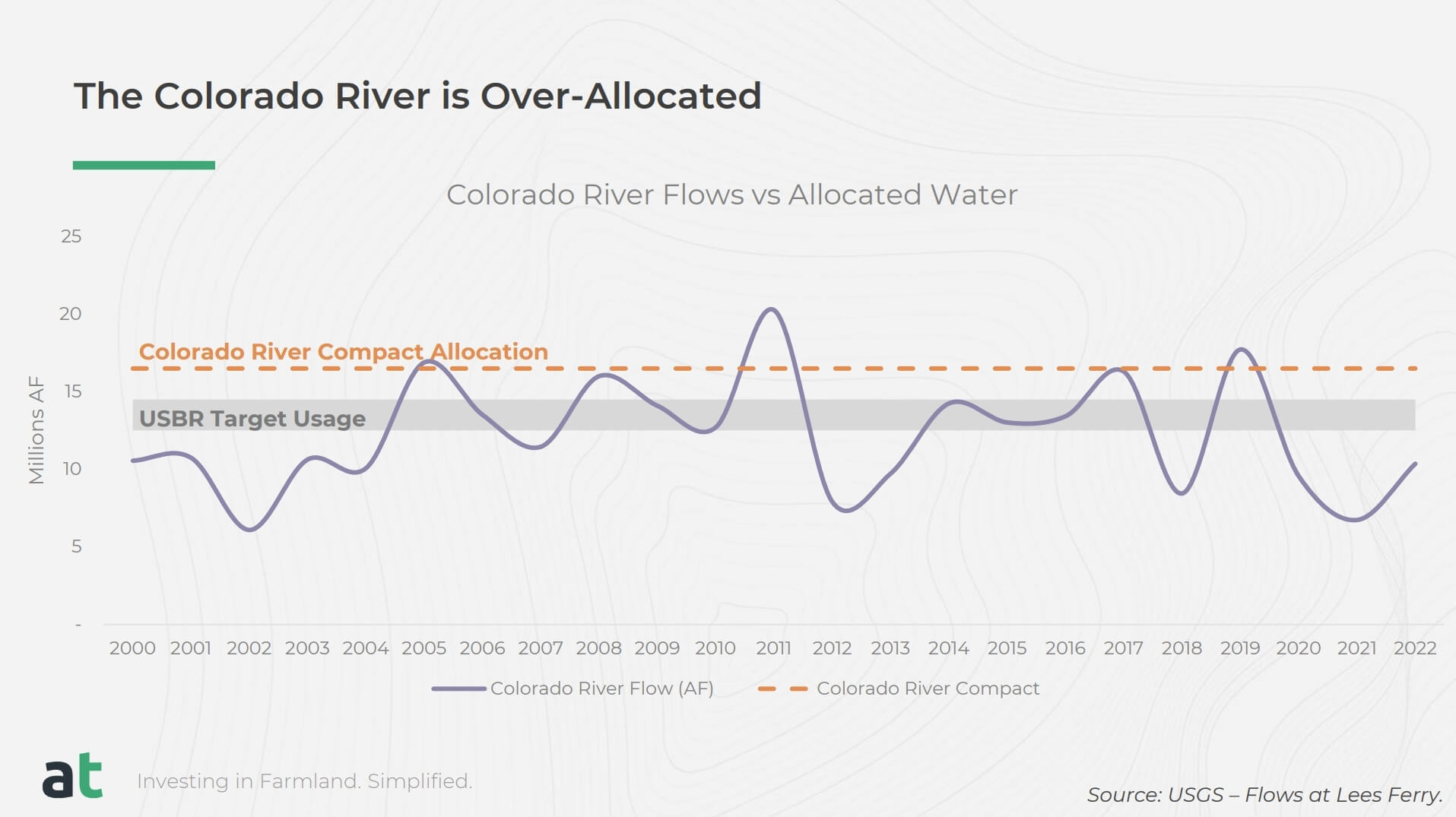
Over the last 20 years demand (i.e. allocated water rights) on the river has outstripped the supply of available water, resulting in contingency plans in 2007 and 2019 for the Lower Basin States.
Figure 2 - Colorado River Flows vs. Allocated Water Rights
 Source: USGS
The 2019 Drought Contingency Plan (DCP) was created to protect the reservoirs of Lake Powell and Lake Mead from falling to critically low levels. The agreement runs through 2026. The agreement required Arizona and Nevada and other junior water right holders to face mandatory cuts. California’s senior rights holders did not face cuts and instead were compensated by entering into voluntary water conservation agreements. The primary burden of the mandatory cuts fell on farmers in central Arizona.
While California’s senior rights holders had no legal obligation to cut their water use, a framework to provide compensation to voluntarily use less water was implemented. The DCP slowed the decline of Lake Mead and established the compensated conservation model as a viable path for a longer term agreement.
Looking Forward - Joint Conservation for Long-Term Management
The Seven States’ Consensus Proposal was outlined in 2024, calling for all seven states representing both the Upper Basin and the Lower Basin to agree to collective conservation goals. This framework maintains the existing priority system and respects the legal seniority of water rights, meaning senior rights holders must be financially incentivized to participate. Importantly, the 3 million acre-feet goal is expected to be divided equally between the Upper and Lower Basin states.
As of September 2025, the Upper and Lower Basin states have yet to produce a unified proposal to submit to the U.S. Bureau of Reclamation (USBR). Each has presented separate proposals to the USBR, who is expected to release a draft that will outline the federal government’s preferred alternative, which will serve as the basis for the final round of negotiations. If the states cannot ultimately agree, the federal government could impose its own solution.
It is worth noting that the key decision makers in the federal government are the Commissioner of the Bureau of Reclamation and the Secretary of the Interior. Both of these recent appointees have stressed an emphasis on states’ rights, a focus on legal precedent and the established law of the river, sympathy for agriculture users and a desire to prioritize economic use.
All of these factors lead us to believe that the existing legal framework of water rights, as perfected by the United States Supreme Court, will remain firmly in place and that the significant economic value of senior water rights will be maintained.

Managing Director
Drew Lipke joined AcreTrader in 2021 and serves as Managing Director, leading the sourcing and underwriting of farms acquired and managed by AcreTrader LLC. Drew brings more than 14 years of experience across debt and equity capital markets, including roles in corporate credit analysis, equity research, and institutional equity sales. Prior to AcreTrader, Drew spent 12 years at Stephens Inc. covering multiple sectors including aerospace and defense, energy exploration and production, and building materials and construction services, and later served as Managing Director of corporate credit analysis at a fixed-income broker dealer. A Little Rock native, Drew has owned farmland in Arkansas for over a decade. He holds Series 7, 24, 63, 79, 86, and 87 licenses with FINRA and is a registered representative of North Capital Private Securities. Drew earned his degree from the University of Georgia’s Terry College of Business and was recognized by Institutional Investor as an All-America Research Team Rising Star.