
2026 Farmland Market Outlook
Key Points:
- Farmland asset values are significantly less volatile than the ag economy. Limited and shrinking supply and the scarcity of farmland support asset values.
- Farmland values have remained resilient despite the difficult environment for many row crop and specialty crop producers.
- The current market conditions have created an opportunity to capitalize on the high dispersion and inefficiencies of the farmland market.
- Outlook for corn and soybeans in 2026.
In the last two years, producers of both commodity row crops and specialty crops have faced a very difficult operating environment. At AcreTrader, we have been reacting to these changing market conditions in real time. As average farmland values have softened, this dispersion or spread around average values has increased. This has created an opportunistic sourcing environment over the last 18-24 months in many regional markets. We have highlighted many times that the ag economy is very different from the farmland market. Simply put, the ag economy is and has always been highly cyclical, while the farmland market has been significantly less volatile. This is due to the fact that the capital cycle breaks down when applied to farmland.
Historically, times of weakness in the ag economy have proven to be opportune times to purchase investment-grade farmland at relatively attractive prices, as we highlighted during the last trade war induced downturn.
Downturns in the ag economy can and do impact farmland investments through potential pressure on lease rates and potentially wider dispersion in farmland values. So what have we seen over the last two years? Our leases are generally longer term as we prefer a partnership approach with the operators we work with. In 2025, approximately 24% of the 136 active farms we manage were up for lease renewal. All but one of those farms were renewed with the existing operator, ~73% were renewed at the same rate or higher, while ~27% were down an average of just ~6%. We have never experienced a vacancy on any farm that we have managed. This points to the importance of owning high quality ground in core farming regions. During the inevitable cyclical downturns of the ag economy, marginal ground can face the greatest risk of lease rate pressure. We mitigate this potential pressure through 1) owning investment-grade farmland and 2) taking a partnership approach with the operators we work with.
As far as farmland values, many expected the combination of lower commodity prices, higher input costs, and higher interest rates to pressure farmland values. According to the USDA, cropland values across the United States increased 4.7% year-over-year in 2025. According to Purdue University, Indiana farmland prices increased 3% - 7.6% depending on the quality of the land, while Iowa State University showed farmland values were largely flat, increasing just 0.7% in 2025.
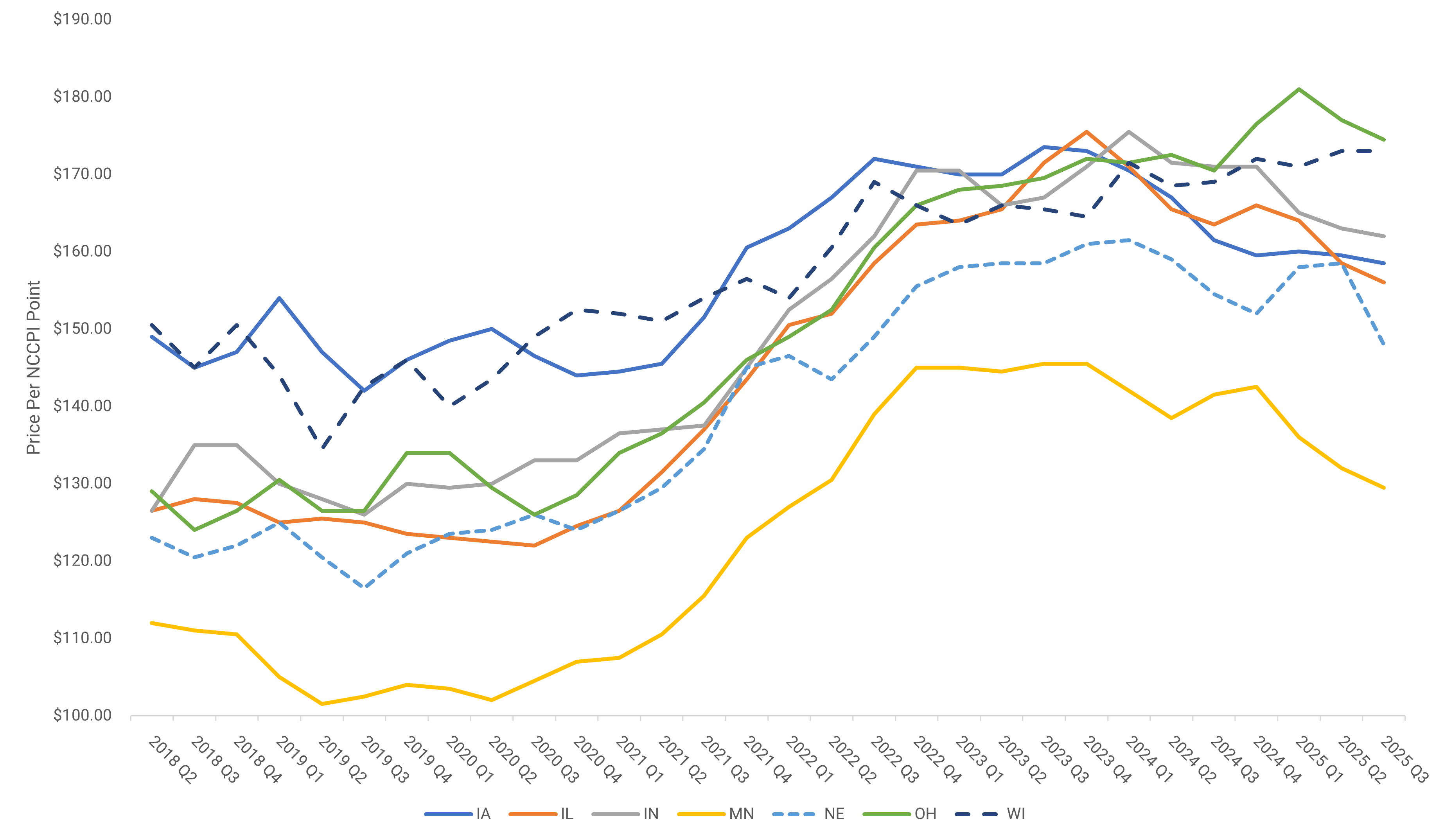
While the survey data from both the USDA and many land grant universities provide valuable, long-term proxies for overall market trends, we prefer to take a data-driven approach, looking at actual transaction data. We believe the market has softened and demonstrated greater variance than these surveys would indicate and we have adjusted to these conditions in our sourcing and underwriting. For markets such as the Midwest, we look at farmland transactions based on the price per tillable acre divided by the productivity index of the soil. For consistency purposes, we look at the price per tillable acre for tracts greater than 35 acres that contain at least 60% tillable acreage and divide that by the National Commodity Crop Productivity Index (NCCPI), which is a measure of the inherent capacity of soil to produce commodity crops without irrigation. Farmland assets are inherently heterogeneous, however by utilizing the law of large numbers, analyzing a large database of actual transactions, and normalizing each transaction for national soil properties, landscape features, and climate, we believe this creates a superior method for tracking trends. Figure 1 shows the price per NCCPI point across 7 Midwestern states. This analysis excludes several core farming regions, such as the Pacific Northwest and Mississippi Delta, however we believe is indicative of the trends we have witnessed over the last 8 years. This analysis looks at over 61,000 transactions across these 7 seven states.
Figure 1 - Average Price Per NCCPI Point
 Source: Acres.com, AcreTrader
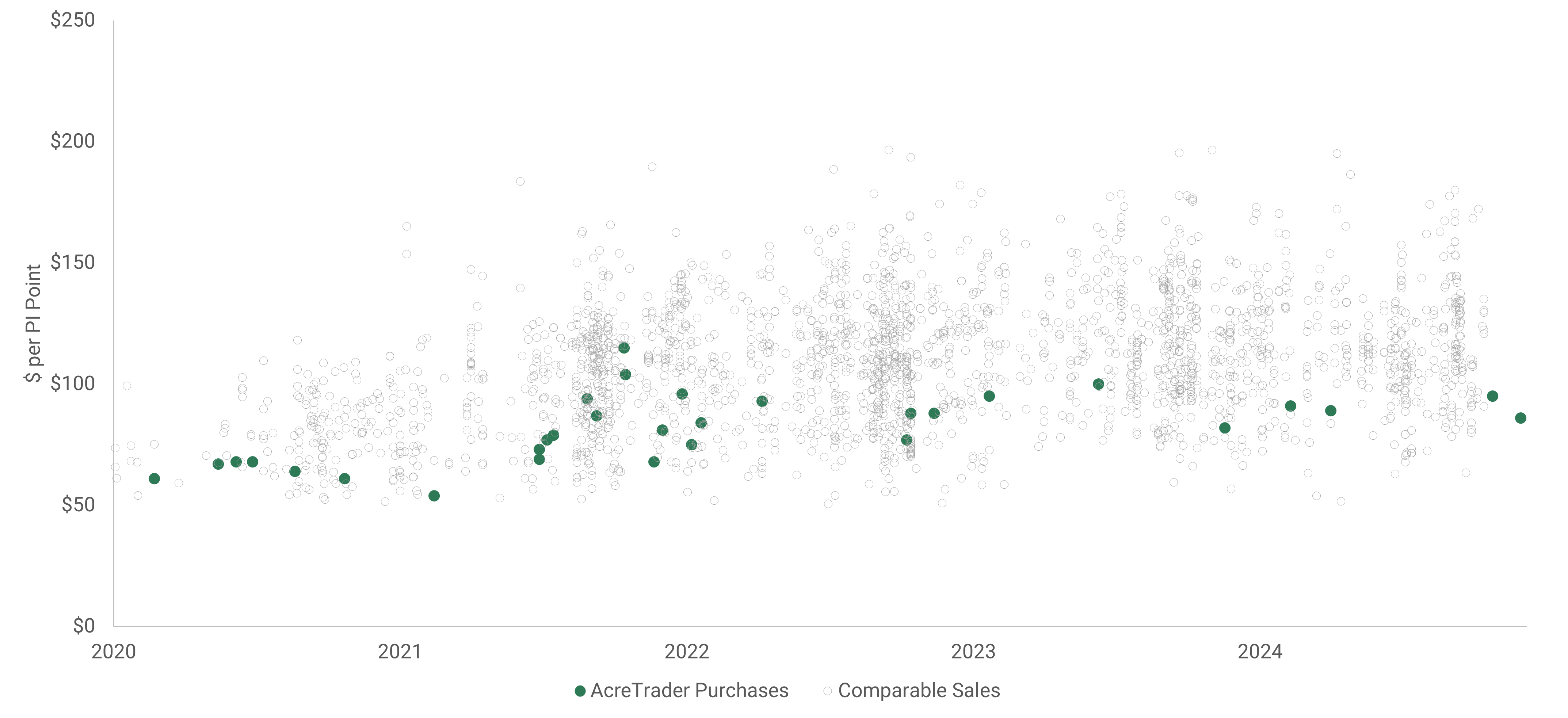
This analysis of transactions shows that average prices peaked in late 2023 or 2024 in many markets and have decreased modestly as of Q3 2025. While average prices have moderated, the significant dispersion in farmland values has continued to present opportunities. Figure 2 shows the average price per point in 6 counties in Illinois over the last 8 years, compared to AcreTrader purchases in these same 6 counties, to demonstrate how we attempt to capitalize on this dispersion. In practice, our farm team saw many opportunities to capitalize on the inefficiencies inherent to the farmland market and these opportunities continue today.
Figure 2 - AcreTrader Acquisitions vs. Overall Market
 Source: Acres.com, AcreTrader
The Ag Economy is Expected to Stabilize in 2026. Government Payments to Provide Additional Support
The consensus among ag economists is that the farm economy is expected to stabilize in 2026 as prices for key commodities such as corn and soybeans appear to have hit their cyclical lows in 2025 (see below), while input cost pressure has stabilized. The agricultural industry is a critical resource to this country and as such is expected to continue to benefit from the safety net provided by both the Farmer Bridge Assistance program and the safety net provided by Agriculture Risk Coverage (ARC) / Price Loss Coverage (PLC) payments. These are critical safety net programs that provide free, baseline protection for farmers against significant price declines or revenue declines.
The Lowly Soybean Became a Media Darling in 2025. The Outlook for 2026.
Soybeans received more media attention than any time in recent history in 2025 as the crop, and soybean farmers, fell subject to political football in light of the new administration’s revived trade wars. Despite the doom and gloom reporting, soybean prices were flat to up slightly in 2025. The forward outlook for the U.S. soybean market will be dependent on offsetting reduced demand from China while also leveraging biofuel growth. The USDA’s January WASDE report projects U.S. season-average farm price for soybeans for 2025/2026 of $10.20 per bushel, compared to the 2024/2025 estimate of $10.00 per bushel. The report’s 2025/2026 projected U.S. stocks to use stands at 8.2%, which points to tight supply.
The recent trade war with China and impact of lower China soybean imports from the United States is part of a much longer term trend that has been unfolding as it pertains to China's food security. In 2025, China purchased 8 million metric tons (MMT) of soybeans from the U.S. This is well below the 45-50 MMT China has historically imported.
Taking a step back, China has been making significant investments in South America to physically control and diversify their supply base since 2013-2014 and the reality is that this issue is part of a long-term trend as China has been working to build and own much of its supply of soybeans for over a decade.
China consumes 115-120 MMT of soybeans annually, the vast majority of which is crushed into meal to feed livestock. As their population has grown and increased wealth it consumes more protein and thus its demand for soybeans has steadily increased. China can only produce ~20 MMT annually, or about 15%-17% of its needs and thus they must import. China has limited arable land and fresh water, which only continues to decrease. Despite significant efforts over the last few decades, China has not been able to increase its domestic production. For this reason, the United States has been a major sourcing region, historically supplying China with ~40% of its soybean needs.
In theory, the South American countries of Brazil, Argentina, and Paraguay can supply the total volume of China's needs today. However in terms of logistics and seasonality, they cannot yet fully replace the U.S. without significant risks to China. Seasonality is important to consider - Brazil's harvest runs February to May with a primary export window March-September. The U.S. harvests September to November with a primary export window October - February. Soybeans are organic and deteriorate over time. To ensure a fresh, steady supply of its crushing plants year-round, China historically needs to alternate between the two sourcing regions. China does not want either the U.S. or Brazil to have a monopoly on this critical supply. So while in any given year China can attempt to punish a supplier, it is unlikely and not in China’s best long-term interest to monopolize their supply base.
In addition, the Mato Grosso region periodically faces drought conditions, as happened in 2024 and this is a further risk to China relying too heavily on Brazil. The U.S. Midwest does not face the same drought risk as Brazil, primarily because of the fact that the U.S. Midwest predominantly consists of Millisols soils, which retain water significantly better than the Oxisols/Ferralsols in Matto Grosso.
In the new normal that has evolved over the last decade plus, most practitioners believe that China will still need the U.S. to supply at least ~20% of its needs, mostly during the winter months. It would take continued, very massive investments in storage capacity that does not exist today, and China accepting the risk of a single-source supplier, to fully displace the United States. It's also important to remember that investment-grade farmland in the United States is the lowest cost producer of soybeans, as we have discussed in the past.
Soybeans are also largely a fungible commodity and China sourcing more from South America then limits South American producers ability to sell into other regions. The rest of the world still needs soybeans and the U.S. is now transforming its export destinations. This is laid out well in this recent University of Illinois article. In 2025, Southeast Asia, North Africa, Europe, and Latin America made up for much of the recent lost export volume to China.
Soybeans are a commodity and with all commodities, the cure for low prices is low prices. Approximately 80% of a crushed soybean is used for soymeal. The USDA forecasts a record 2.57 billion bushel crush in 2025/2026. Currently depressed soybean prices, coupled with increased capacity and a weaker U.S. dollar should make U.S. soymeal significantly more competitive on the global stage and allow U.S. soymeal exports to increase.
In addition, soybean oil has emerged as a primary feedstock for renewable diesel and lower feedstock prices help to increase renewable diesel margins. Over the last 5 years the U.S. has seen an expansion in crush capacity, largely due to the improved regulatory outlook for renewable diesel over the last 5 years.
Finally, the regulatory environment for increased demand from U.S. grown soybeans as the primary feedstock for renewable diesel is more favorable now than at any time in recent history. For example, the current administration has proposed changes to domestic biofuel policy with changes in the Renewable Fuel Standard quotas and extending the Clean Fuel Production Credit through 2029, both of which are expected to increase domestic demand for soybeans. The U.S. Congress still needs to clarify policy around the enforcement of the 45Z tax credit restrictions and the EPA needs to finalize renewable volume obligations for 2026 and 2027, however the momentum to secure domestically produced soy oil as the preferred feedstock in biofuel production remains.
With U.S. stocks to use at tight levels, a potential normalization of trade tensions, a realignment of trade partners, increased domestic demand and increased domestic crush capacity, the outlook for soybean prices points to 2024-2025 levels representing the cyclical low for soybean prices.
The USDA’s January WASDE report projects the average farm price for corn in 2025/2026 to be $4.10 per bushel, compared with $4.24 per bushel estimate in 2024/2025. The U.S. stocks to use stands at 13.6%. This points to a balanced market, though this is the highest level in 6 years due to a projected record 17 billion bushel harvest. Recent U.S. corn exports have been particularly strong, despite the fact that almost no exports have been shipped to China. Prices for 2026 could swing based on weather in South America, U.S. planted acreage in 2026, and/or ethanol policy support such as year-round E15 for the summer 2026 driving season.
2026 Farmland Outlook
As we highlighted in last year’s outlook, commodity prices, input costs, interest rates, and weather are all likely to remain volatile, as they have demonstrated in the past. We believe investment-grade farmland in the United States will remain a low-cost producer on the global stage and the long-term trends of an increasing global population that consumes more calories per capita and more protein per capita as a result of global economic growth will continue to drive increased demand from our country’s greatest natural resource. While past performance is no guarantee of future results, we continue to believe that the limited and shrinking supply base of investment-grade farmland, coupled with demand for and on that farmland will result in both relatively limited volatility and increased farmland values over the long-term. The resilience of farmland values through 2024 and 2025 in the face of a difficult operating environment support this thesis.

Managing Director
Drew Lipke joined AcreTrader in 2021 and serves as Managing Director, leading the sourcing and underwriting of farms acquired and managed by AcreTrader LLC. Drew brings more than 14 years of experience across debt and equity capital markets, including roles in corporate credit analysis, equity research, and institutional equity sales. Prior to AcreTrader, Drew spent 12 years at Stephens Inc. covering multiple sectors including aerospace and defense, energy exploration and production, and building materials and construction services, and later served as Managing Director of corporate credit analysis at a fixed-income broker dealer. A Little Rock native, Drew has owned farmland in Arkansas for over a decade. He holds Series 7, 24, 63, 79, 86, and 87 licenses with FINRA and is a registered representative of North Capital Private Securities. Drew earned his degree from the University of Georgia’s Terry College of Business and was recognized by Institutional Investor as an All-America Research Team Rising Star.